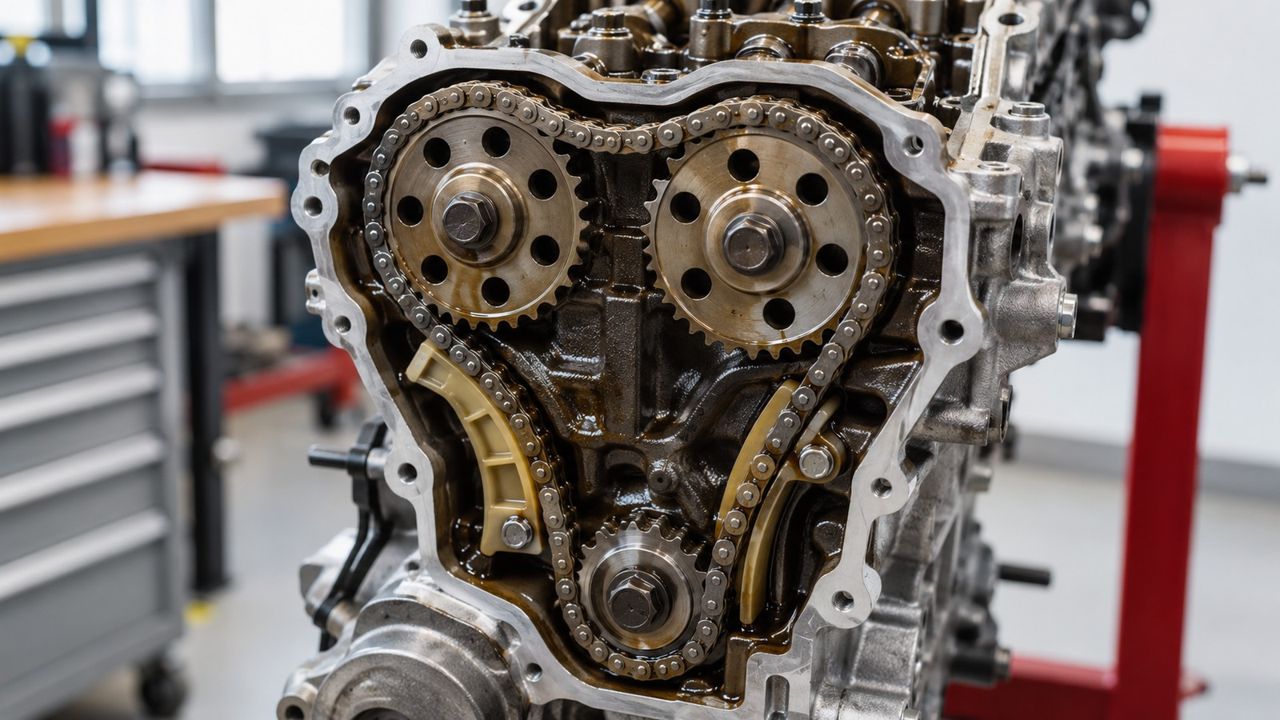
A startup rattle or a camshaft-related trouble code deserves investigation before you buy a used car, but neither proves that the timing chain needs replacement. The correct next step is a diagnosis tied to the exact engine, its service history, and the manufacturer’s repair information. Do not accept a seller’s explanation that the noise is normal without checking it independently.
Timing-chain concerns are especially easy to oversimplify because similar symptoms can have different causes. A chain, tensioner, guide, oil-related problem, or another component may be involved. The useful question is not whether an entire brand has “bad chains.” It is whether this vehicle has a documented fault, what the applicable procedure says, and what work has already been completed.
Identify the engine before researching the problem
Write down the VIN, model year, engine, and mileage. A model name alone may cover several engines with different timing systems and service procedures. Ask a shop or dealer to identify the engine from the vehicle information rather than relying on a badge or an advertisement. Then use that identification when requesting service records or searching manufacturer communications.
NHTSA provides a year, make, and model search that includes manufacturer communications. Those documents can help identify a known symptom and the conditions under which a manufacturer recommends a particular diagnostic procedure. Read the applicability section carefully: engine codes, production dates, and other restrictions matter.
For example, a MINI service action published through NHTSA describes cold-start or idle rattling associated with the timing-chain tensioner on certain N14 engines. Its stated production range is specific. That is evidence about those vehicles and that procedure; it is not proof that every rattle on every MINI, or every other car, has the same cause.
Arrange to hear the car start cold
Ask the seller to leave the vehicle unstarted before the inspection. Explain that you want the mechanic to evaluate any startup noise under the conditions described in the relevant bulletin. If the car is already warm when you arrive, do not pretend the cold-start check has been completed. Arrange another opportunity if that condition matters to the diagnosis.
Describe the sound and circumstances accurately. Does it occur only at initial startup, continue at idle, or appear under a particular operating condition? A recording can help convey the symptom, but it cannot replace inspection. Avoid repeatedly starting an engine with a concerning mechanical noise just to make a better recording.
Keep yourself away from moving parts and do not remove covers while the engine is running. If a warning tells you to stop the engine, follow the owner’s manual. An inspection is not a reason to continue operating a vehicle that is displaying an urgent warning.
Treat diagnostic codes as clues
Have a qualified technician read the diagnostic information and explain what it means for the exact engine. Ask for the code numbers and written findings. A verbal statement that “the scanner says chain” leaves out the diagnostic steps needed to establish the cause.
A Subaru bulletin available through NHTSA illustrates why this matters. Its procedure for certain camshaft/crankshaft-related codes includes checks involving software, learning values, oil level and condition, the chain, wiring, and oil pressure. The sequence depends on the specified vehicle and results. It is not a universal checklist to apply to another engine, but it shows why replacing parts solely because a familiar code appears can be the wrong conclusion.
If the seller says the warning was cleared and never returned, ask what repair preceded that action and request the invoice. Clearing a warning and documenting a completed repair are different pieces of evidence. Let the inspecting shop decide whether further operation or testing is appropriate before treating the issue as resolved.
Read the service history for the right details
Ask for dated maintenance invoices showing mileage and the work performed. Compare the documented maintenance with the schedule and oil specification for that engine. Do not substitute a generic oil-change interval from another vehicle. A missing receipt does not prove neglect, but it leaves a gap you should acknowledge when deciding whether to buy.
If a timing-chain repair is claimed, request the itemized repair order. Look for the original symptom, diagnosis, parts replaced, and any follow-up work. “Timing repair” is too vague to establish whether the shop replaced a tensioner, a chain assembly, or something else. Have your inspector review the invoice against the current symptoms.
Ask whether an applicable campaign was checked and whether the work was completed under a warranty, service action, or recall. These terms do not mean the same thing. NHTSA’s VIN recall tool does not display manufacturer customer-service or other non-safety campaigns, so contact a dealer about those separately. A service bulletin by itself does not establish a right to a free repair.
Get a diagnosis and a written estimate before negotiating
The FTC recommends an independent mechanical inspection before buying a used car, including one sold with a warranty or service contract. Ask the shop to include the VIN and a written estimate of necessary work. For a suspected chain problem, ask what has been confirmed, what remains uncertain, and whether additional diagnostic labor is needed.
Compare estimates by scope rather than headline price. Ask whether the proposed work includes the parts identified by the diagnosis, associated seals or fluids, and any further inspection that could change the bill. Avoid treating a seller’s informal repair allowance as a complete repair quotation.
A sensible purchase decision needs three things together: an explanation of the symptom, a credible repair plan, and a price that accounts for the documented work. If the shop cannot resolve the uncertainty before purchase, consider another car. You do not have to become an engine specialist to recognize that an unresolved mechanical issue is an unresolved buying risk.
Models where timing chain complaints cluster
In the federal complaint data we track, timing chain complaints are concentrated in a few engines. The 2012 and 2013 Chevrolet Equinox and GMC Terrain with the 2.4-liter four-cylinder are known for burning oil, which can wear the chain early. The 2012 and 2013 Volkswagen Tiguan and the 2012 Chevrolet Traverse also drew timing chain complaints. Each model page shows which years drew the most reports and the service bulletins that apply.
Questions
Does a startup rattle always mean a bad timing chain? No. Noise alone does not identify the failed part. Have a technician evaluate the exact engine and the conditions under which the noise appears, using applicable manufacturer information.
Does a timing-chain bulletin mean the repair is free? Not automatically. A bulletin provides service information. Ask the manufacturer or dealer whether a recall, warranty extension, or other coverage applies to this VIN and repair.
Should every high-mileage timing chain be replaced before purchase? Do not apply a universal replacement rule. Check the exact vehicle’s maintenance requirements, symptoms, diagnostic results, and repair records. Ask the inspecting technician for a recommendation supported by those findings.