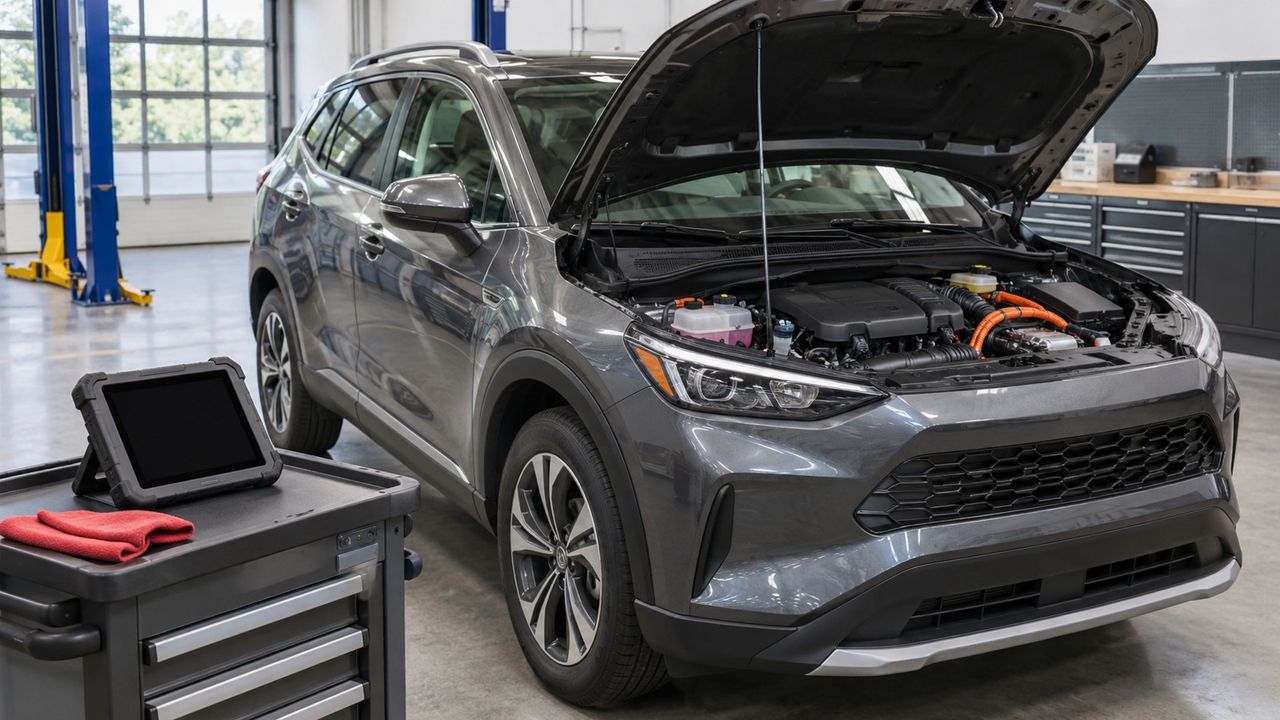
A used hybrid can look clean, start normally, and still leave an important question unanswered: what condition is its high-voltage battery in? There is no single dashboard number that answers that question for every hybrid. A useful assessment combines the exact vehicle’s service history, a thorough test drive, a warranty check, and diagnosis by someone familiar with that hybrid system.
Start by identifying what you are buying. A conventional hybrid, a plug-in hybrid, and a battery-electric vehicle do not have the same charging arrangements or driving behavior. This guide focuses on hybrids, including plug-in models. It does not assume that every vehicle offers a standardized battery-health certificate or a guaranteed remaining service life.
Identify the battery and the vehicle
Ask for the vehicle identification number, model year, trim, mileage, and original in-service date. Compare the VIN on the vehicle with its paperwork. Use the manufacturer’s owner’s manual to identify the hybrid system and its maintenance requirements. A listing that says only “new battery” is not enough: ask whether that means the small auxiliary battery or the high-voltage traction battery.
Those are different components. For example, Toyota’s hybrid manuals distinguish the 12-volt battery from the hybrid battery. Replacing an auxiliary battery does not document replacement or restoration of the traction battery. Request the invoice, part description, installation date, mileage, and warranty terms for any battery work the seller describes.
If the traction battery has been repaired or replaced, ask exactly what was supplied. An invoice should resolve whether the work involved a complete pack or individual components, and who stands behind it. Do not assign extra value to a repair based on an advertisement’s terminology alone. Have the inspecting technician review the documentation and check whether the installed parts match the vehicle.
Check the warranty before discussing replacement costs
Hybrid coverage is specific to the manufacturer, model year, component, and applicable warranty terms. It also has time and mileage limits. The remaining period depends on the vehicle’s original coverage start date, not the date you buy it used. Ask an authorized dealer to check the VIN and provide the applicable warranty information.
Toyota provides a useful example of why the details matter. Its published hybrid warranty information distinguishes hybrid battery coverage for 2020 and newer model years from earlier vehicles. It also distinguishes battery coverage from coverage for other hybrid components. That is not a rule to apply to a different brand or a promise that any particular failure will qualify. Read the actual warranty guide for the vehicle, including exclusions and any state-specific provisions.
Warranty coverage and battery health answer different questions. A battery can operate normally today with little or no warranty remaining. A vehicle can also have remaining coverage without a current test establishing its condition. Keep the written warranty check and mechanical assessment as separate pieces of evidence.
Ask for a hybrid-specific inspection
The FTC recommends an independent mechanical inspection before buying a used vehicle. For a hybrid, choose a shop that can evaluate the relevant high-voltage system, rather than accepting a basic inspection that omits it. Tell the shop that battery condition is part of your purchase decision before booking the appointment.
Ask the technician to explain which manufacturer-supported checks are available for that model. Depending on the vehicle and diagnostic equipment, the assessment may include stored faults, battery-related operating data, temperature information, and cooling-system inspection. A list of trouble codes alone is not the same thing as a complete battery evaluation. Request a written explanation of findings and limitations.
Be cautious about a seller’s screenshot showing a reassuring percentage without identifying the test, vehicle, date, or measurement conditions. Ask what the number actually represents and whether the manufacturer recognizes that procedure. Do not compare percentages from different applications as though they were equivalent laboratory measurements. A shop should be able to explain its result in terms that help you make a purchase decision.
Use the test drive to identify questions
Read the owner’s manual before the drive so you understand normal indicators and warnings. Arrange a route that allows the vehicle to operate in ordinary traffic and at road speed where appropriate. Watch for warnings and note unusual behavior for the technician. If a warning directs you to stop, follow the manual rather than continuing the test to gather more information.
The energy display is useful context, but it is not a universal battery-life meter. Engine operation, battery charging, and electric assistance are managed by the vehicle. Do not conclude that the battery has failed merely because the engine starts, or that it is healthy because the car briefly moves under electric power. Ask the technician to interpret behavior against that model’s normal operation.
For a plug-in hybrid, ask to see charging demonstrated using compatible equipment and the procedure in its manual. Record the starting charge level and the conditions of the drive. A displayed electric-range estimate is not a substitute for a diagnostic assessment. Avoid treating one short trip as a controlled capacity test.
Inspect cooling provisions safely
Battery cooling deserves attention. Toyota’s published instructions, for example, explain that dust and clogging at certain hybrid battery intake vents or filters can affect cooling and fuel economy. Locate the relevant intake in the exact vehicle’s manual. Check for obstruction, accumulated debris, or missing maintenance records, and ask the technician whether cleaning or further inspection is needed.
Do not remove high-voltage covers, disconnect orange cables, or attempt internal battery measurements yourself. Manufacturer instructions place restrictions on high-voltage system work. Keep the buyer’s inspection to permitted observations and let a qualified technician handle diagnosis. Water damage or evidence of unsafe electrical alterations warrants a professional assessment before further operation.
Turn the findings into a buying decision
Before committing, assemble four items: the written inspection, battery-work invoices, the VIN-specific warranty information, and a written estimate for any work the inspection identifies. Ask whether the estimate includes diagnosis, parts, labor, and any related work. A quote for a different model or a different type of replacement is not a reliable budget for this vehicle.
There is no need to demand a prediction of the exact month a battery will fail. Instead, establish what is known now, what remains uncertain, and whether the asking price leaves room for those uncertainties. If the seller refuses a suitable inspection or cannot explain claimed battery repairs, pause the purchase until the missing evidence is available.
Questions
Does a replacement 12-volt battery mean the hybrid battery is new? No. The auxiliary battery and high-voltage traction battery are different components. Read the invoice and ask the technician to identify what was replaced.
Can a normal test drive prove the battery has years left? No. A test drive provides observations about present operation. It cannot guarantee remaining life. Combine it with service records and a model-appropriate inspection.
Is a battery still under warranty automatically a safe purchase? Remaining coverage is useful, but it does not replace inspection. Verify the coverage terms and assess the vehicle’s current condition separately.