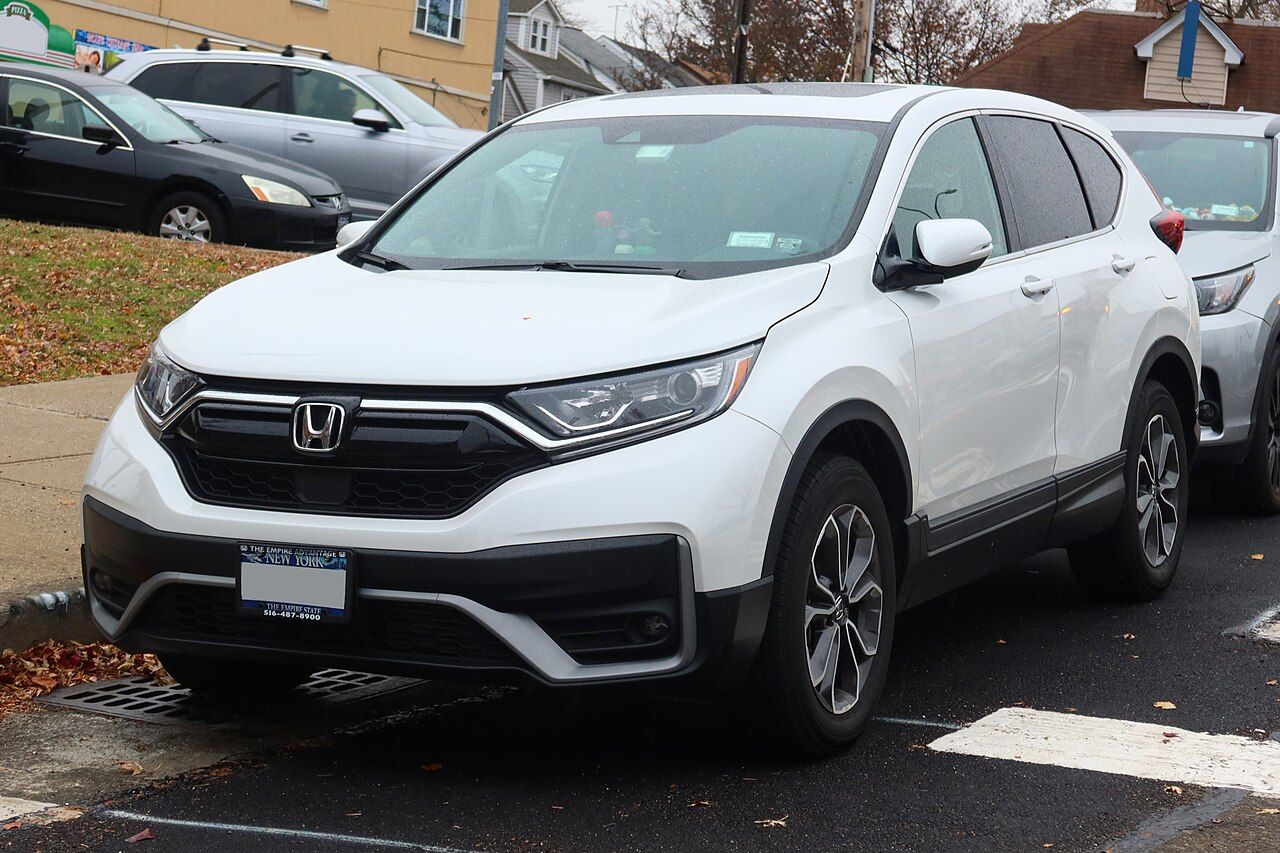
The best CR-V years to buy are 2016 and 2021. Skip the 2017 and 2018 unless the seller can show the engine software update: the new 1.5L turbo drew more than twice the usual complaints, mostly for fuel mixing into the oil.
Best years: 20162021 Years to avoid: 20172018
Every CR-V year compared
Owner complaints per 100,000 cars sold. Lower is better. The newest years have had less time to collect complaints, so they are marked too new to judge.
Known CR-V problems
Year by year
| Year | Complaints | Per 100k sold | Recalls | Top issue | Rating |
|---|---|---|---|---|---|
| 2024 | 483 | - | 5 | Steering | Too new to judge |
| 2023 | 633 | - | 8 | Steering | Too new to judge |
| 2022 | 351 | 147 | 6 | Steering | Good year |
| 2021 | 447 | 124 | 5 | Steering | Good buy |
| 2020 | 447 | 138 | 9 | Collision avoidance | Good year |
| 2019 | 1,108 | 288 | 8 | Collision avoidance | Average |
| 2018 | 2,165 | 571 | 5 | Fuel System | Watch out |
| 2017 | 1,781 | 471 | 7 | Engine | Skip this year |
| 2016 | 395 | 111 | 3 | Engine | Good buy |
| 2015 | 673 | 195 | 3 | Engine | Average |
| 2014 | 588 | 176 | 1 | Engine | Average |
| 2013 | 382 | 126 | 2 | Engine | Good year |
| 2012 | 403 | 143 | 3 | Engine | Good year |
About the CR-V
The CR-V is one of the most reliable compact SUVs you can buy used, which is why its weak years stand out. Most problems cluster in the first two years of the 2017 redesign, when Honda switched to a small turbocharged engine. Later years fixed the oil issue but traded it for complaints about sticky steering and jumpy automatic braking, which are annoying rather than costly.
- 2012-2016: 2.4L non-turbo engine, simple and durable. Early CVT years (2015-2016) can shudder at idle, usually fixed with a software update.
- 2017-2022: 1.5L turbo. Fuel-in-oil complaints peak in 2017-2018; later years mostly bring steering and collision-system complaints. Hybrid added in 2020.
- 2023 on: Current generation. Too new to judge fully; early complaints focus on steering feel.
CR-V warranty extensions and special coverage
Carmakers sometimes extend the warranty on a part that fails too often, or pay for a fix outside a recall. These notices come from the dealer bulletins Honda files with NHTSA. 884 CR-V bulletins are on file in total.
Due to a new North America regulation which introduces a new refrigerant and oil requirement the compressor shaft seal may leak.
Due to a new North America regulation that introduces a new refrigerant and oil requirement, the compressor shaft seal may leak.
Today, April 5, 2019, American Honda is announcing a warranty extension for certain 2016-18 Civic and 2017-18 CR-V vehicles due to drivability concerns.
This bulletin is replaced by S/B 19-032, Warranty Extension: 2017-18 CR-V: Software Update with A/C Replacement; DTC P0300, P0301, P0302, P0303, P0304, or P0172; Whirling Noise from Engine.
This bulletin is a notification of a class action settlement relating to airbag inflators.
Ask a dealer to check a specific car by VIN. Extensions usually have a time or mileage limit.
Government investigations into the CR-V
NHTSA opens an investigation when complaints point to a possible safety defect. Some end in a recall and some close without one.
Preliminary evaluation PE25016 · 2020–2022 · opened Oct 2025
The Office of Defects Investigation (ODI) has received 48 Vehicle Owner Questionnaire (VOQ) reports and some Early Warning Reporting (EWR) field reports alleging intermittent loss of motive power in Model Year (MY) 2020–2022 Honda CR-V Hybrid vehicles.
Engineering analysis EA24002 · 2017–2022 · opened Apr 2024
On February 21, 2022, the Office of Defects Investigation (ODI) opened Preliminary Evaluation (PE22003) to assess reports of inadvertent activation of the Collision Mitigation Braking System (CMBS), an automatic emergency braking (AEB) system, in model year 2017-2019 Honda CR-V and 2018-2019 Honda Accord vehicles.
Engineering analysis EA23003 · 2023, 2024 · opened Nov 2023, closed Jan 2025 · led to recall 24V744
On November 29, 2023, the Office of Defects Investigation (ODI) opened this Engineering Analysis (EA23003) to assess allegations of momentary increase in steering effort in model years (MY) 2022-2023 Honda Civic, 2023MY Honda CR-V, and 2023MY Acura Integra vehicles (subject vehicles).
Defect petition DP22005 · 2020–2022 · opened Jan 2023, closed Aug 2023 · led to recall 22V063000
NHTSA received a petition on or about July 18, 2022, requesting that Federal Motor Vehicle Safety Standard (FMVSS) 141 be applied to all electric and hybrid vehicles operating in the United States.
Preliminary evaluation PE22011 · 2018–2022 · opened Nov 2022, closed Jul 2024
On November 29, 2022, the Office of Defects Investigation (ODI) opened PE 22-011 after reviewing field reports alleging rear differential seizure in 2018-2022MY Honda CR-V and HR-V vehicles equipped with all wheel drive.
Preliminary evaluation PE22003 · 2017–2019 · opened Feb 2022, closed Apr 2024
On February 21, 2022, the Office of Defects Investigation (ODI) opened Preliminary Evaluation (PE22003) to assess reports of inadvertent activation of the Collision Mitigation Braking System (CMBS), an automatic emergency braking (AEB) system, in model year 2017-2019 Honda CR-V and 2018-2019 Honda Accord vehicles.
Engineering analysis EA21002 · 2012–2015 · opened Sep 2021
From 2000 through 2017, Takata produced millions of air bag inflators using two types of phase-stabilized ammonium nitrate ("PSAN") propellant -- propellant 2004 and propellant 2004L.
Engineering analysis EA19001 · 2012–2016 · opened Apr 2019, closed Sep 2024 · led to recall 20V024
The Office of Defects Investigation (ODI) opened this investigation to determine if the failure of airbags to deploy during severe crashes, in certain vehicles, was the result of a safety related defect.
Investigation EQ12002 · 2012 · opened Feb 2012, closed May 2012
The summary for this investigation, labeled EQ12-002 Autoliv Closing Resume, can be found attached separately to this resume.This EQ is closed.
CR-V vs rivals
Which years drew fewer problems per car soldHonda CR-V vs Nissan Rogue
Which years drew fewer problems per car soldHonda CR-V vs Mazda CX-5
Which years drew fewer problems per car soldHonda CR-V vs Chevrolet Equinox
Which years drew fewer problems per car soldHonda CR-V vs Hyundai Tucson
Which years drew fewer problems per car soldHonda CR-V vs Subaru Forester
Which years drew fewer problems per car soldJeep Cherokee vs Honda CR-V
Which years drew fewer problems per car soldVolkswagen Tiguan vs Honda CR-V
Which years drew fewer problems per car sold
Questions
What is the best year for the Honda CR-V?
2016 and 2021. The best CR-V years to buy are 2016 and 2021. Skip the 2017 and 2018 unless the seller can show the engine software update: the new 1.5L turbo drew more than twice the usual complaints, mostly for fuel mixing into the oil.
Which Honda CR-V years should I avoid?
2017, 2018. These drew far more owner complaints per car sold than the Honda CR-V average.
What is CR-V oil dilution?
On short trips in cold weather, some unburned fuel slips past the piston rings of the 1.5L turbo into the oil. The oil level rises and smells of gas. Honda released a software update in 2019. Cars that had it and get regular oil changes usually do fine.
Is the CR-V Hybrid reliable?
The hybrid (2020 on) has a similar complaint rate to the gas model. Its most common complaints are about steering feel and the collision system, not the hybrid parts.
Based on 9,856 complaints filed by owners with U.S. safety regulators for model years 2012 to 2024, and U.S. sales by calendar year. How we score.